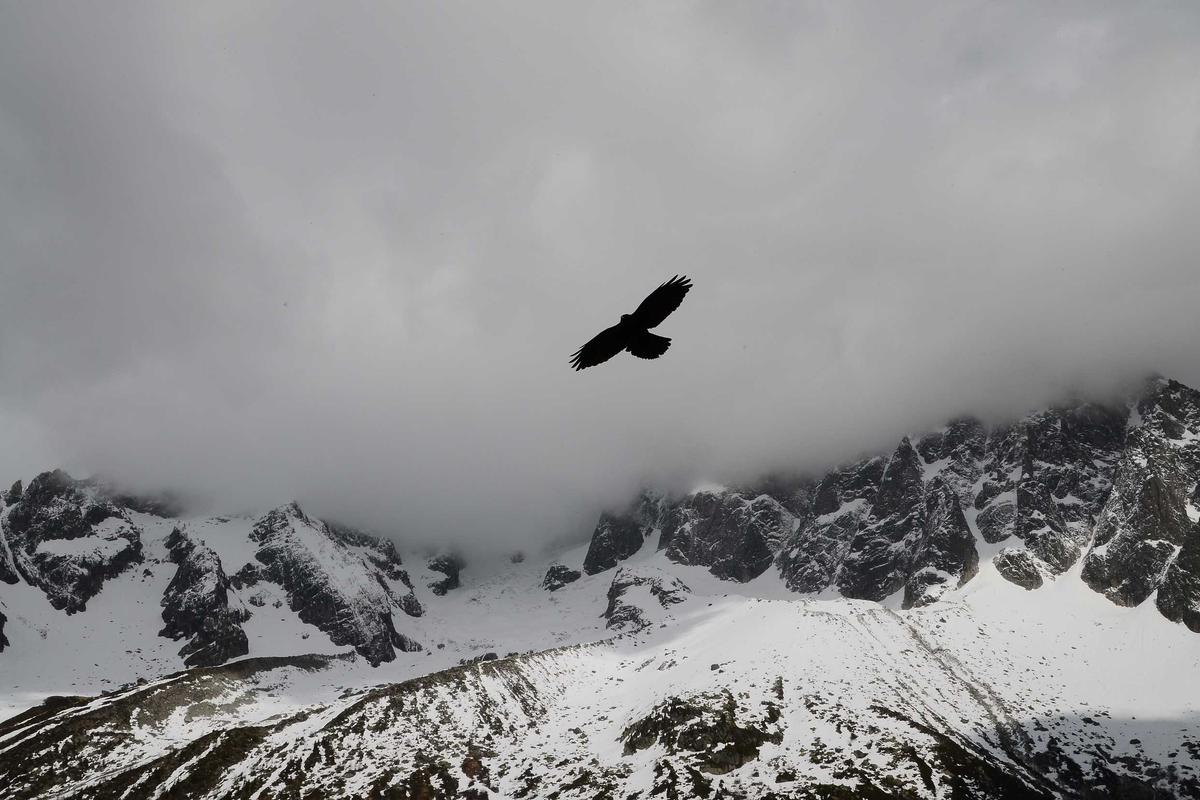
A mountaineering guide’s astonishing survival after being stranded for 72 hours on Everest’s lethal ‘Death Zone’ has reignited a fierce debate about safety standards on the world’s highest peak. The guide, a 38-year-old Nepali climber, was found semi-conscious at 8,500 metres, having endured hurricane-force winds and temperatures below -40°C without food, water, or shelter. His rescue, which involved a complex helicopter operation at the edge of the mountain’s technical limits, has been hailed as miraculous. But for UK mountaineering experts, the incident underscores a systemic failure in regulation that they argue is turning Everest into a high-altitude lottery.
Dr. Rebecca Thornton, a mountaineering physician at the University of Oxford, described the conditions as ‘physiologically impossible for survival beyond a few hours’. She noted that the guide’s survival likely owed to a combination of genetic resilience and extreme luck, but warned that such outcomes are rare. ‘This is not a testament to human endurance. It is a warning that the current approach to climbing Everest is unsustainable.’
The incident is the latest in a climbing season that has seen 18 deaths and dozens of rescue operations. Critics point to the commercialisation of Everest, where permits are issued to inexperienced climbers with little oversight. The Nepali government, which issued 478 permits this year, has faced renewed calls to enforce stricter criteria, including compulsory experience at altitude, medical checks, and mandatory use of supplementary oxygen above 8,000 metres.
The UK’s Alpine Club, one of the oldest mountaineering organisations in the world, has released a statement calling for an international summit to standardise safety protocols. ‘We cannot continue to treat Everest as a bucket-list destination where the price of a permit replaces the need for competence,’ said club president Sir Alistair Finch. ‘The industry is selling a fantasy of adventure while ignoring the physical reality of the mountain. The consequences are predictable and lethal.’
The logistics of high-altitude rescue are themselves fraught. The helicopter that retrieved the guide was operating at the limit of its performance, with reduced lift capacity due to thin air. ‘Every rescue on Everest is a near-failure,’ explained Captain Rajendra Singh, a veteran helicopter pilot who has conducted over 100 Everest rescues. ‘We cannot guarantee extraction above 8,000 metres. The window for safe operation is minutes, not hours.’
Yet the economic realities of Nepal complicate any reform. Tourism accounts for 8% of the country’s GDP, and Everest alone generates millions in permit fees. ‘The government is caught between safety and revenue,’ observed Dr. Thornton. ‘But the human cost of inaction is mounting. We are seeing bodies left on the mountain because retrieval is too dangerous. That is an abdication of responsibility.’
The guide, whose name has been withheld for privacy, is now recovering in a Kathmandu hospital. His survival has prompted a brief media frenzy, but the underlying question remains: how many more close calls will it take before the system changes? As one mountaineering official put it, ‘We are gambling with lives, and the odds are getting worse.’
In the high Himalayas, the air is thinning, the ice is retreating due to climate change, and the crowds are growing. The next rescue may not be miraculous. For UK experts, the call for reform is not a demand for closure but a plea for a system that acknowledges the limits of human endurance against the immutable physics of altitude. The mountain, as always, will have the final word.